Whether you’ve just moved in or your key has started sticking on cold mornings, a front door lock you can’t trust is worth fixing. For most standard doors, replacing the deadbolt or handle set is a manageable DIY job: modern locks are built to swap into the same holes, so if you can use a screwdriver, you can usually do it without drilling.
This guide walks through measuring, choosing the right lock, removing the old one, installing the new one and adjusting the strike plate so the bolt slides in without a push. It also covers when it makes more sense to call a locksmith.
Signs your lock needs replacing
- The handle or deadbolt wobbles even after you tighten the screws.
- The key sticks, catches or only works if you jiggle it.
- The bolt drags against the strike plate or doesn’t fully extend.
- The finish is corroded, or the lock was damaged in a break-in attempt.
If the lock works fine and you just want to keep old keys out, you don’t need a new lock: rekeying is cheaper and keeps your existing hardware.
First, check what kind of lock you have
Open the door and look at its edge.
- Tubular (most modern homes): the lock sits in a round hole through the door face, and the plate on the door’s edge is small, around 1 by 2¼ inches. This guide is for this type.
- Mortise (many older Denver homes): the lock body sits in a deep rectangular pocket cut into the door’s edge, with a tall faceplate about 6 inches or longer. Mortise locks are more complex and are best replaced or converted by a locksmith.
Measure before you buy
Packaging often says “universal fit,” but locks aren’t one-size-fits-all. Take three measurements before you go to the store:
- Backset: the distance from the edge of the door to the center of the large round hole. It’s almost always 2⅜ or 2¾ inches. Most new locks have an adjustable latch for both, but check the box.
- Door thickness: usually 1¾ inches for exterior doors.
- Bore hole diameter: the large round hole, usually 2⅛ inches.
If your numbers are different, your door may need drilling or a special lock, which is a good point to bring in a professional.
Choose the right lock
Two deadbolts can look identical on the shelf and perform very differently. Check the ANSI grade on the box:
- Grade 1: the strongest, built for commercial use. A great choice for a front door.
- Grade 2: solid residential security, fine for most exterior doors.
- Grade 3: basic. Use it for interior doors, not exterior ones.
Thinking about a smart lock? Motorized locks need a door that closes without a shove; if the bolt has to fight the frame, the motor strains and the batteries drain fast. Fix any alignment problems first, and check that your Wi-Fi reaches the door if you want remote access. See our smart lock installation.
Want one key for the whole house? Buy the same brand as your other locks, and ask whether the store can key the new one to match. A locksmith can also rekey it to your existing key.
Remove the old lock
You don’t need the old key. Removing a lock is purely mechanical.
- Unscrew the inside half. On a deadbolt, remove the two screws on the inside thumb-turn plate. On a handle, remove the screws on the inside rose (some handles have a small release slot instead; press it with a small screwdriver and pull the handle off).
- Pull both halves off the door. If paint has glued the outside half to the door, slide a plastic putty knife under the edge to break the seal without gouging the wood.
- Remove the latch or bolt. Unscrew the plate on the edge of the door and slide the latch out.
Install the new lock
- Insert the latch or bolt into the hole in the door’s edge. For a handle latch, the slanted side must face the direction the door closes, so it slides against the frame instead of banging into it. Screw the plate in place.
- Fit the outside half. Slide it through the door so the flat metal bar on its back (the tailpiece) passes through the slot in the latch. For a deadbolt, the tailpiece usually sits horizontal.
- Check for a “TOP” or “UP” mark on the inside mounting plate and line it up. On keypad and smart locks, route the cable through without pinching it.
- Fit the inside half and start the long screws by hand so they don’t cross-thread. Tighten them snug, but not hard; overtightening can bind the mechanism.
- Test with the door open. Turn the key and the thumb-turn several times. The bolt should extend and retract smoothly without grinding.
Adjust the strike plate
Even a great lock is useless if the bolt hits the wood instead of the hole. The strike plate, the metal plate on the door frame, has to line up with the bolt.
- Close the door and lock it. If you have to push, pull or lift the door to turn the key, the strike plate is out of line.
- Move the plate slightly up, down or deeper into the frame until the bolt slides in on its own. You may need to enlarge the hole behind it with a chisel.
- Use longer screws. Most locks come with short strike plate screws that only reach the trim. Swap them for 3-inch screws that reach the framing behind it. It’s one of the cheapest ways to make a door much harder to kick in.
Final check: the bolt extends fully, the door doesn’t rattle when locked, and every screw head sits flush.
When to call a locksmith instead
DIY works well for a standard tubular lock in a door that closes properly. Call a professional if:
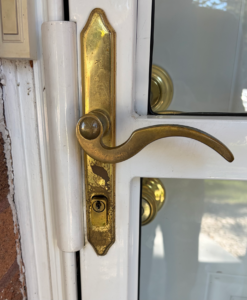
- You have a mortise lock or a multipoint lock on a modern composite or patio door.
- Your measurements don’t match standard locks, and the door would need drilling or new holes.
- The door or frame is damaged, for example after a break-in.
- You want a high-security lock, or every door keyed to match.
- The bolt still won’t line up after adjusting the strike plate. The door itself may need adjusting.
A locksmith can supply and install the lock, rekey it to match your other doors and align the frame in one visit. See our residential locksmith services.
Keep your new lock working
Twice a year, puff a little graphite or dry PTFE lubricant into the keyhole and work the key a few times. Avoid oily sprays, which collect dust and eventually gum up the lock, especially in Denver’s dry, dusty air.
Would rather not do it yourself, or hit a snag halfway? Call or text Lucky Lock at 720-453-7334 for lock replacement anywhere in Denver and Aurora.